




Bergamot Oil in Natural Perfume — Scent, Longevity & Blending Guide
What Is the Most Attractive Smell in Perfume?
Bergamot is consistently ranked among the most attractive scents in perfumery, valued for its rare ability to bridge citrus brightness with a soft, floral-spicy depth that suits both feminine and masculine compositions. purelyBlack's Bergamot Essential Oil is available as a 100% pure essential oil, dispatched from Sydney.
- Universal appeal: Bergamot's citrus-floral balance makes it one of the few top notes that works equally well in fresh, oriental, and woody fragrance families.
- Perfumery role: Used as a top note in the vast majority of commercial fine fragrances — from classic eaux de cologne to modern niche perfumes.
- Earl Grey association: Its scent is instantly recognisable as the defining character of Earl Grey tea, giving it broad cultural familiarity.
- Blending versatility: Pairs naturally with lavender, cedarwood, and patchouli — oils that anchor its volatile citrus character into longer-lasting blends.
- Chemical reason: High linalyl acetate content (25–40%) gives bergamot a floral smoothness rarely found in other citrus oils, making it more complex and wearable.


Bergamot's dominance in fine fragrance comes down to chemistry. Its linalyl acetate content positions it between a citrus and a floral, giving blenders a top note that opens brightly but doesn't evaporate into nothingness — it leaves a smooth aromatic trail that heart notes can build on naturally.
Is There a Perfume That Smells Like Bergamot?
Yes, many widely recognised perfumes feature bergamot as a dominant top note — it appears in the opening of countless classic eaux de cologne and modern citrus-woody fragrances.
- Eau de cologne tradition: The original Cologne formula (4711) is built almost entirely on bergamot, lemon, and neroli — bergamot provides its signature fresh opening.
- Earl Grey-forward perfumes: Several niche perfumers have created scents specifically designed to capture the bergamot-tea character, with bergamot as the star rather than a supporting note.
- DIY alternative: A simple bergamot-dominant blend can be made at home by combining bergamot with a small amount of lavender and cedarwood in a carrier base.
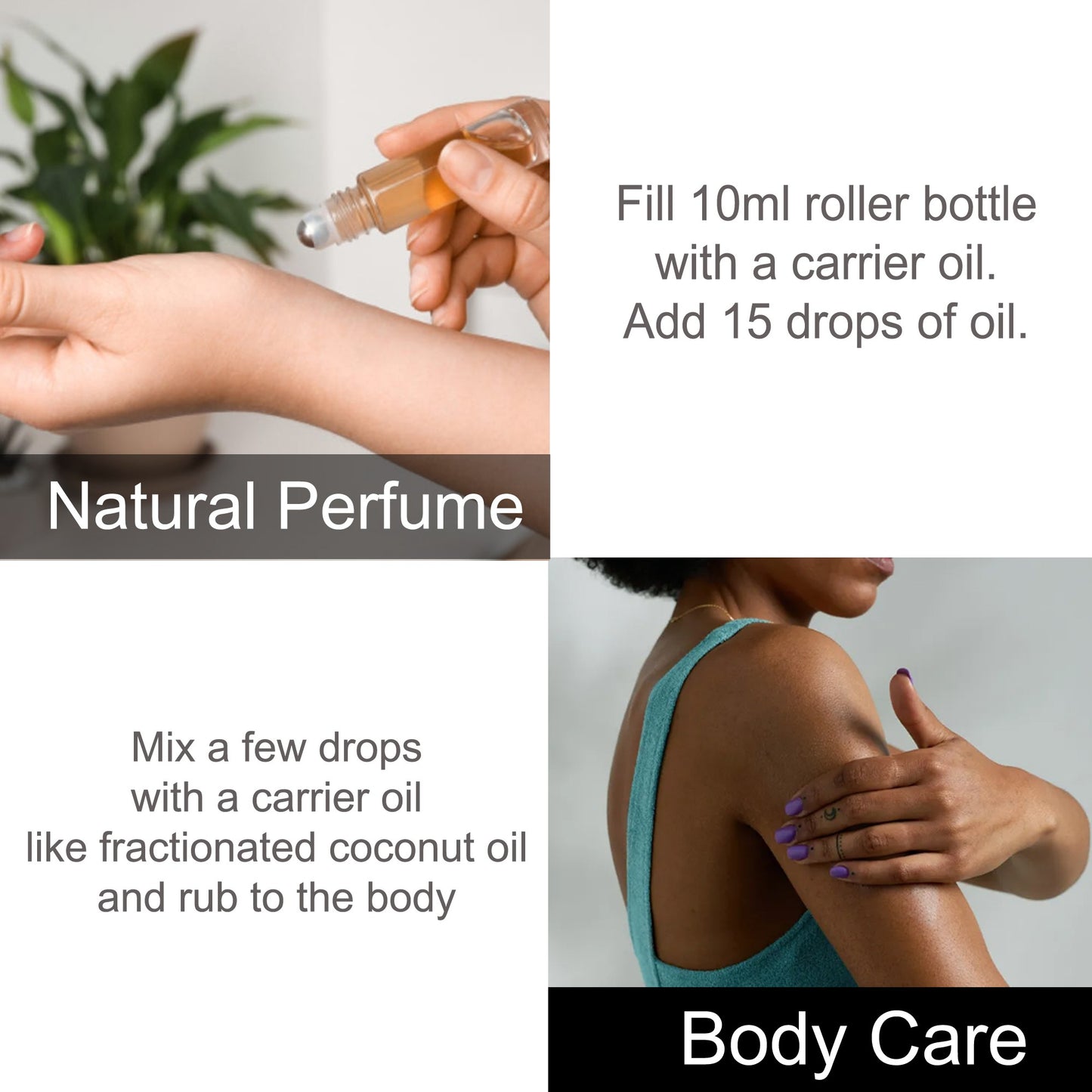
- Concentration matters: In commercial perfumes, bergamot is typically used at 5–15% of the total formula — at home, 4–6 drops in a 10ml roller is a workable starting point.
For Australian perfume enthusiasts looking to recreate a bergamot-forward scent at home, the simplest approach is to combine bergamot with patchouli as a fixative base. Patchouli slows the evaporation of the citrus top note, extending how long the bergamot character stays perceptible on skin. Add Fractionated Coconut Oil as the carrier — it's odourless and absorbs cleanly, letting the bergamot character come through without distortion.


What Does Bergamot Oil Smell Like?
Bergamot oil smells like a sharp, sun-drenched citrus with a distinctly floral and lightly spicy undertone — closer to a complex orange-lemon hybrid than a straightforward citrus.
- Opening note: Bright, tart, and sparkling — sharper than sweet orange, more floral than lemon.
- Mid-development: A green, slightly rose-adjacent floral quality emerges as the initial citrus burst settles.
- Dry-down: Subtly spicy and woody, contributed by γ-terpinene and β-pinene in the oil's constituent profile.
- Earl Grey reference: The scent is immediately familiar to most people as the defining aroma of Earl Grey tea — a useful shorthand for the uninitiated.
- Botanical source: Extracted by cold pressing from the rind of Citrus bergamia (Rutaceae family), grown primarily in Calabria, southern Italy.
The complexity of bergamot's aroma is what separates it from other citrus oils. Where lemon or grapefruit read as single-dimensional in a blend, bergamot carries three distinct phases — citrus, floral, and spice — that make it behave more like a multi-note accord than a simple top note.
Is Bergamot a Masculine or Feminine Scent?
Bergamot is considered a gender-neutral scent — it appears in both traditionally masculine colognes and feminine perfumes, with its character shifting depending on what it is blended with.
- Masculine direction: Paired with black pepper, cedarwood, or vetiver, bergamot reads as crisp, sharp, and distinctly cologne-like.
- Feminine direction: Combined with rose, ylang ylang, or jasmine, the floral facets of bergamot come forward, making it softer and more traditionally feminine.
- Unisex default: On its own or with lavender, bergamot sits comfortably in gender-neutral territory — clean, bright, and broadly appealing.
- Historical context: Bergamot has been a cornerstone of both men's cologne and women's eau de toilette for over two centuries.
The gender flexibility of bergamot makes it one of the most useful oils in a home blending kit. A single bottle can anchor a sharp morning cologne or a soft evening fragrance simply by changing the base and heart notes it is paired with. For aromatic use at home, see our guide on bergamot oil for aromatic grounding.
How Long Does Bergamot Oil Last?
As a top note, bergamot essential oil typically lasts 20–45 minutes on skin as a standalone, but when blended with base notes such as cedarwood or patchouli, the overall fragrance can persist for several hours.
- Volatility class: Bergamot is a high-volatility top note — its small molecular weight means it evaporates quickly compared to heart or base notes.
- Extending longevity: Pairing with a fixative base note (patchouli, vetiver, or frankincense) significantly slows the evaporation rate of the full blend.
- Skin condition: Well-moisturised skin holds fragrance longer — applying a carrier oil to skin before the perfume blend creates a lipid matrix for the molecules to grip.
- Concentration: Higher bergamot concentration in a blend extends initial perception but does not change the underlying evaporation chemistry.
- Shelf life: As a bottled oil, bergamot has a shelf life of approximately 12–18 months before oxidation affects its aromatic quality — store in a cool, dark location.
For skincare and congestion routines using bergamot, see our guide on bergamot oil for oily skin.
About the Author
Written by H.R. Kim
Founder at purelyBlack — an Australian-owned perfumery and essential oil supplier based in Sydney. H.R. specialises in molecular ingredient chemistry and scent profiling, with a focus on pure, single-origin essential oils for aromatherapy, skin care, and natural wellness.
Last updated: August 2026
Disclaimer: This article is for general educational purposes only and does not constitute medical advice. It is not intended to diagnose, treat, cure, or prevent any disease. These statements have not been evaluated by the Therapeutic Goods Administration (TGA). Always dilute before topical use, patch test before wider application, and consult a qualified healthcare professional before use during pregnancy or if managing a medical condition.
